Vega’s eiderdown landscape: keep care and labor inside the scenic view
A northern coastal landscape can look sparsely occupied while containing a detailed history of work. The Vega Archipelago offers a subject that connects fishing, farming and eiderdown harvesting. Read the landscape through the labor described by its heritage interpretation, giving care and organization their place without turning birds or working structures into attractions a visitor is entitled to approach.
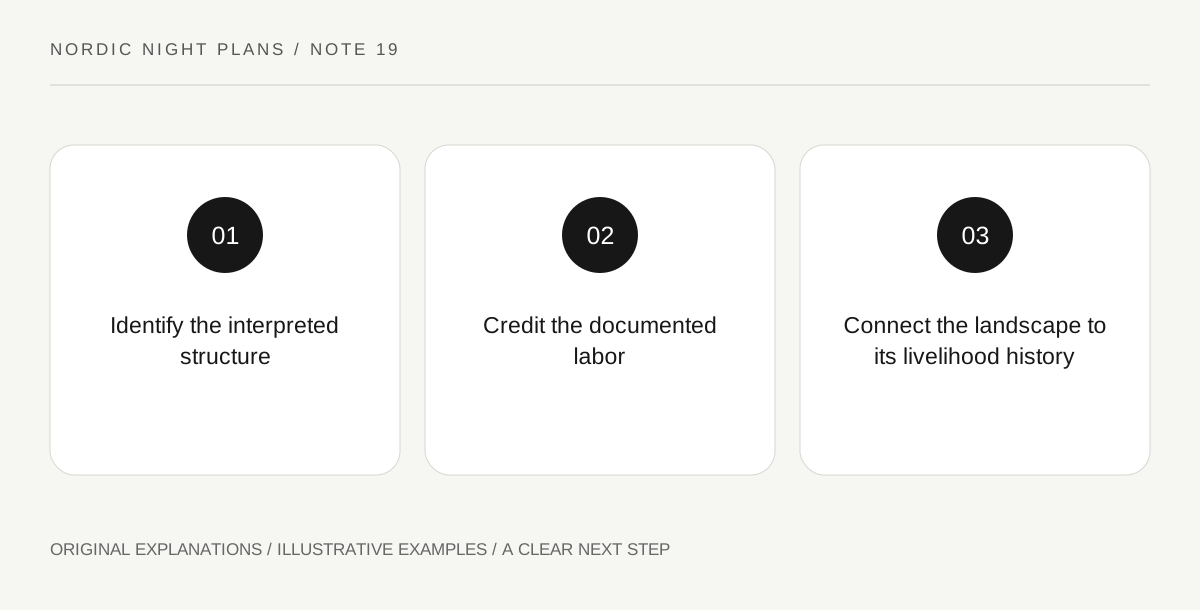
Original explanatory diagram. Read the full method and limitations below.
Begin with the cultural-landscape account
UNESCO describes Vegaøyan as a cultural landscape associated with fishing and eiderdown harvesting, including eider houses and other working structures. Its account emphasizes women’s contribution to the down-harvesting tradition. Keep those relationships in view before choosing a scenic image. The source supports a history of work; it does not establish a current wildlife encounter, an active nest location or permission to enter productive areas. A broad heritage map should therefore lead to interpretation, not an improvised search for birds.
Give the visible structure a documented role
Choose an officially interpreted image, object or authorized view of a named structure. Record what the interpretation says it was for, then describe one visible feature without adding an unverified operational explanation. A small building can look simple while depending on knowledge that a visitor cannot infer from its outline. If you want to understand a task, use the institution’s account. Do not test a guess by entering, opening or handling a working or historic structure.
Write the labor into the caption
List the roles actually identified in the interpretation and distinguish named people from more broadly described contributions. Keep women’s work visible where the source establishes it, without inventing an individual biography to make the story personal. Ask which actions a landscape photograph would conceal: organization, maintenance or other documented tasks relevant to the selected subject. The question helps explain why an apparently empty scene may be culturally dense. It also prevents a scenic caption from reducing a working landscape to a backdrop with no people in its history.
Choose an encounter that serves the question
An interpretation centre, official collection or authorized account may answer the question without a boat outing or wildlife approach. If another activity interests you, establish its actual current format separately. End with a paragraph connecting the selected structure, documented labor and wider livelihood context. Do not present eiderdown harvesting as a practice you can learn to perform from a travel article. The educational goal is recognition and credit: understanding how a landscape’s value can include relationships and work that a beautiful view alone does not reveal.
Illustrative learning notebook
Illustrative caption: a traveler studies an official image of a labeled eider-related structure and writes its documented role beside the source’s account of women’s contribution. The final paragraph connects building and labor while leaving individual identities unknown where not supplied. The traveler chooses interpretation over an assumed nest visit and adds no claim of a current bird encounter or hands-on harvesting experience.
Questions that come up
Does the heritage designation guarantee a bird encounter?
No. It explains cultural significance, not a current encounter or access arrangement. Use the actual provider’s information for any separate activity.
Can a scenic image explain the whole livelihood system?
No. It can prompt a question, while interpretation supplies context about work and relationships that the image cannot establish alone.
References and scope
These sources support the factual background. Examples and exercises are original illustrative teaching material. References do not imply endorsement.
- UNESCO: Vegaøyan – The Vega Archipelago — Fishing/eiderdown cultural landscape, eider houses and women’s contribution to harvesting; no wildlife-access or practical harvesting instruction.