A magnetosphere drawing: separate the planet, the field and the plasma
Before a northern-lights trip, a space diagram can provide a better question than another spectacular photograph. Read one official magnetosphere illustration by separating its different kinds of marks. The planet, the magnetic-field lines and the representation of plasma are related, but they are not interchangeable objects that would all be visible to a traveler looking upward.
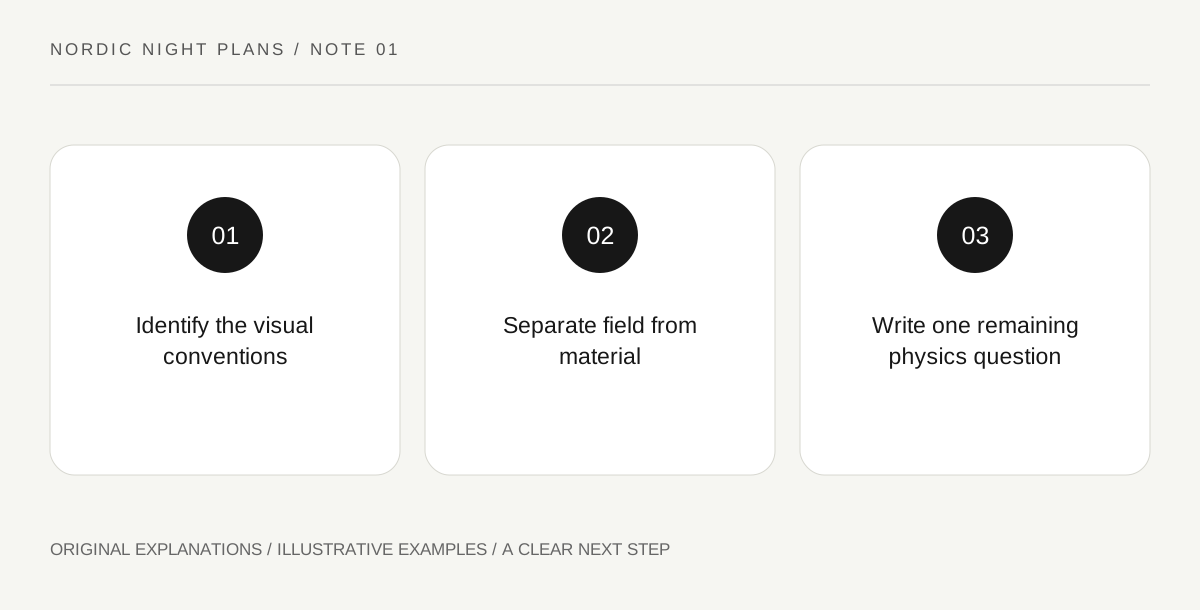
Original explanatory diagram. Read the full method and limitations below.
Identify what the illustration represents
NASA explains the magnetosphere’s shape through the interaction of the solar wind with Earth’s magnetic field. Its illustrations represent a surrounding physical environment rather than a solid shell. Start by writing the image’s title, producer and stated purpose. Then identify the planet and any directional labels. This first pass prevents an attractive colored region from being mistaken for a layer of ordinary cloud. The drawing is useful because it organizes relationships that a human observer cannot simply see in their entirety from the ground.
Give the marks separate notebook keys
Make three keys for body, field and material. Put Earth under body; use field for lines that represent magnetic relationships; use material only where the caption identifies particles or plasma. Leave an uncertain feature outside the keys until the source explains it. These are reading aids, not a new scientific classification system. The method is particularly valuable when several visual conventions overlap. A colored arrow may indicate direction rather than an actual beam, and a smooth boundary may simplify a changing region rather than trace a permanent wall.
Ask what scale has been simplified
Look for wording about scale and perspective. If the caption does not establish a measurable scale, do not calculate distances from the picture. A drawn field line is not a track that a spacecraft photographs as a visible wire. Write a sentence explaining what the drawing helps you understand, then another identifying what it cannot establish. This encourages a useful kind of visual literacy: a diagram can be scientifically informative without being a literal view or a map suitable for measuring every feature.
Connect the picture to one aurora question
Finish by identifying the part of the story that still needs explaining, such as how energy reaches particles or how the upper atmosphere produces light. Keep the connection specific. The diagram does not tell you whether your hotel will have a clear sky or when a display will begin. Its value lies in replacing a vague image of material simply pouring onto Earth with a more careful set of relationships. Carry that question into a science exhibition or an authoritative explanation during the daytime part of the journey.
Illustrative learning notebook
Illustrative reading: a traveler initially calls a colored boundary a shell around Earth. They reread the caption, separate field lines from plasma shading and revise the description to a represented region of interaction. The notebook ends with a question about energy transfer. It includes no distances measured from the illustration and no claim that the colored diagram predicts the view from a Nordic town.
Questions that come up
Are magnetic-field lines visible wires?
No. In this context they are a visual representation used to explain magnetic relationships. Do not read the drawing as a photograph of physical cables.
Can the diagram tell me where to stand tonight?
No. It supplies scientific context at a very different scale. A local viewing decision requires actual local arrangements and current conditions.
References and scope
These sources support the factual background. Examples and exercises are original illustrative teaching material. References do not imply endorsement.
- NASA: Earth’s Magnetosphere, Protecting Our Planet from Harmful Space Energy — Interaction of solar wind and Earth’s magnetic field shaping the magnetosphere; diagram-reading exercises are original.