Vadsø’s Ruija Kven Museum: keep migration, language and one object connected
A northern place name can conceal histories of movement that cross today’s national categories. At Vadsø’s Ruija Kven Museum, study one interpreted object or account in relation to migration and language. The aim is to keep a specific history connected to its evidence, rather than treating a minority identity as a decorative addition to a traveler’s map.
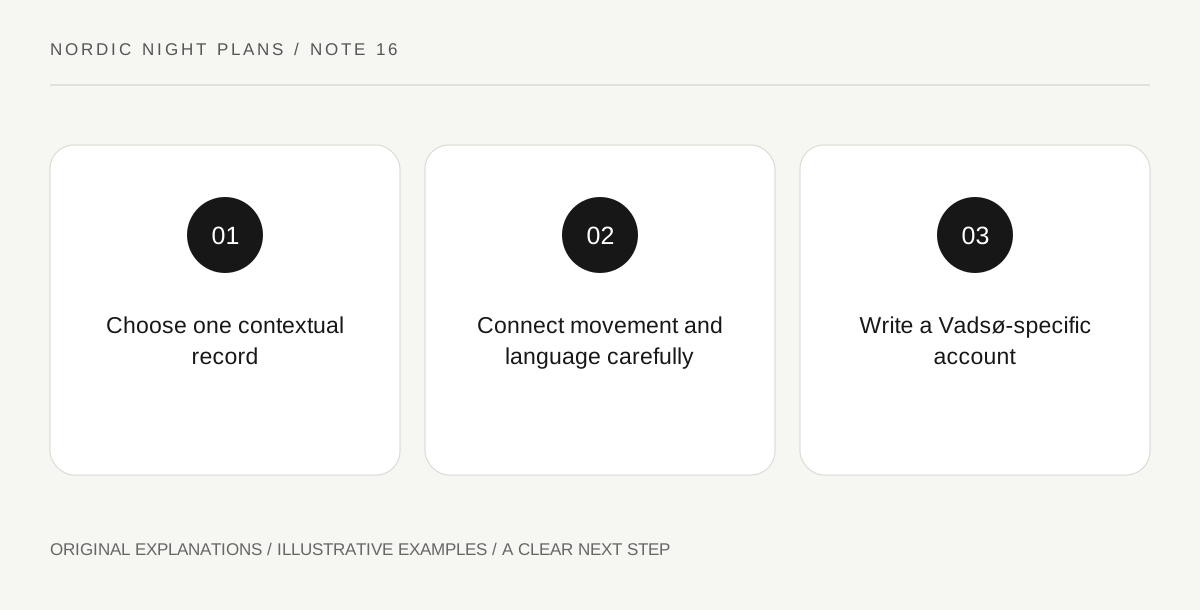
Original explanatory diagram. Read the full method and limitations below.
Use the institution’s particular responsibility
Varanger Museum identifies its Vadsø department with Kven history and describes migration from Finland and the Torne Valley as part of the area’s history. This gives the visit a subject distinct from the organization’s other departments. Record the actual institution and chosen display instead of assuming a shared museum name means interchangeable collections. Use the terminology supplied by the interpretation, while recognizing that names and identities should not be assigned to a contemporary person solely from appearance or a visitor’s guess.
Attach movement to a specific record
Choose a labeled object, account or document that the display connects to the migration subject. Record what moved, who is identified and which places or period the interpretation supplies. If the object’s personal history is unknown, leave it unknown. Do not turn a generic tool into the property of an imagined migrant family to make the story more touching. A concrete account with limits can reveal more than a sweeping narrative whose emotional details were invented by the person writing the travel journal.
Treat language as evidence with a context
Where the display supplies a name, term or language-related record, copy only a brief identifier needed for your note and record its source. Ask what role the language element plays in this particular history. It may identify an object or preserve an account, depending on the display; do not assume the same role everywhere. Avoid inventing a translation or using a familiar-looking word to infer an entire biography. If a term is unclear, use the museum’s explanation or retain a question for appropriate follow-up.
Write a place-specific memory
End with a paragraph that links the chosen evidence to Vadsø’s interpreted history of movement and community. Keep the conclusion specific enough that it could not be pasted onto any northern town. A broader question about language transmission or belonging can remain open, but it should grow from the record actually studied. This gives the daytime visit an independent purpose during an aurora journey and preserves the distinction between a place used as a viewing base and a community with its own histories.
Illustrative learning notebook
Illustrative note: a visitor chooses one labeled record and writes its stated period and place connections. A language-related identifier is retained with the museum context, while a missing personal attribution remains blank. The final paragraph explains the record’s connection to the migration theme. It does not invent a family narrative, translate an unfamiliar term by resemblance or assign an identity to current residents.
Questions that come up
Can a surname or place name establish a person’s identity by itself?
Do not make that inference. Identity and history require appropriate context, and present people should not receive labels based on a traveler’s guess.
Must I know the language before visiting?
No. Use the interpretation and available language support. A clear question is better than an invented translation or a confident misunderstanding.
References and scope
These sources support the factual background. Examples and exercises are original illustrative teaching material. References do not imply endorsement.
- Varanger Museum: English departmental overview — The Vadsø department’s Kven-history responsibility and migration context; no individual identity, translation or opening arrangement is inferred.