Siida: read seasons as relationships rather than a replacement calendar
A northern trip often begins with a month on a booking calendar. Siida offers a different educational question: how can seasonal change connect nature, livelihood and cultural knowledge? Use the museum’s own interpretation to study one relationship, while avoiding the assumption that a visitor can translate a seasonal concept into fixed dates or a personal prediction of local conditions.
Original explanatory diagram. Read the full method and limitations below.
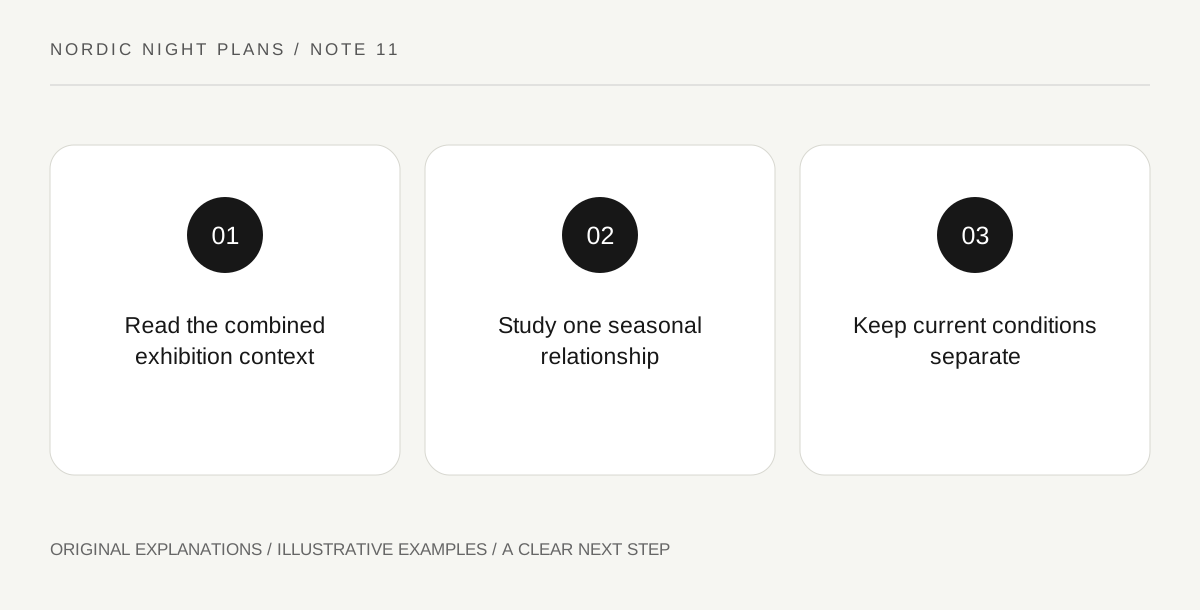
Read the exhibition’s combined subject
Siida’s official account describes a main exhibition joining Sámi culture and Northern Lapland’s nature, including seasonal change. Its nature-centre page refers to the Sámi Homeland’s eight seasons. Treat that as an invitation to learn from the institution’s own explanation, not permission to invent eight equal slices of a calendar. Record the exact cultural and geographical context. The concept is being presented within a particular exhibition, and it should not become a universal rule imposed on every northern community or every visitor’s itinerary.
Choose one interpreted connection
Select a display that links a seasonal change with a named ecological or cultural subject. Record the relationship in your own words and note what kind of evidence explains it: an object, image, account or diagram. Keep the source’s terminology where needed, but avoid collecting isolated words as decorative travel vocabulary. The useful question is what changes, for whom and in relation to what. One clearly understood connection provides more learning than a long list of seasonal labels without an explanation of their meaning.
Keep cultural knowledge separate from a weather decision
Write a second note distinguishing the exhibition’s educational framework from the current information needed for the actual day. A cultural explanation does not establish road conditions, an outdoor route’s suitability or the timing of a particular natural event during your stay. Use the appropriate local authority or provider for those practical questions. This separation lets the museum teach a richer way of thinking about change without asking it to function as a weather forecast or operational notice for a traveler’s next activity.
Bring the relationship into the trip journal
End with a sentence explaining how the display changed one assumption you brought with you. Perhaps a month label now seems less informative than a relationship among land, animals and work. Keep that as a learning response rather than claiming to have mastered a community’s knowledge after one visit. If you use a cultural term later, preserve its context and spelling from the institution. The result is a more attentive northern journey, where the daytime study has its own value alongside any hoped-for aurora encounter.
Illustrative learning notebook
Illustrative note: a visitor initially expects the exhibition to provide eight fixed date ranges. Instead, they choose one interpreted relationship between seasonal change and life in the region. Their notebook explains that connection and separately records where current activity conditions must be checked. The learning entry uses the institution’s context without claiming that a museum visit grants expertise in Sámi seasonal knowledge.
Questions that come up
Should I convert the seasons into equal blocks of dates?
Do not impose that assumption. Learn the framework as the institution explains it and keep a booking calendar separate from cultural interpretation.
Does understanding a display qualify me to explain every Sámi tradition?
No. A focused visit can deepen one question while leaving substantial learning ahead. Preserve the specific context and avoid generalizing to all communities.
References and scope
These sources support the factual background. Examples and exercises are original illustrative teaching material. References do not imply endorsement.
- Siida: Exhibitions and guided tours, Nature Centre — The main exhibition’s link between northern nature and Sámi culture and its eight-seasons framing; no fixed calendar or condition claim.