Arktikum’s Northern Ways: compare regions without making Lapland one story
A destination label can make a large region sound culturally and historically uniform. Use Arktikum’s Northern Ways exhibition to complicate that shortcut. Choose a small comparison across its regional structure, keeping the place, time and evidence attached to each example so that a northern journey gains a more specific geography than a single snowy backdrop.
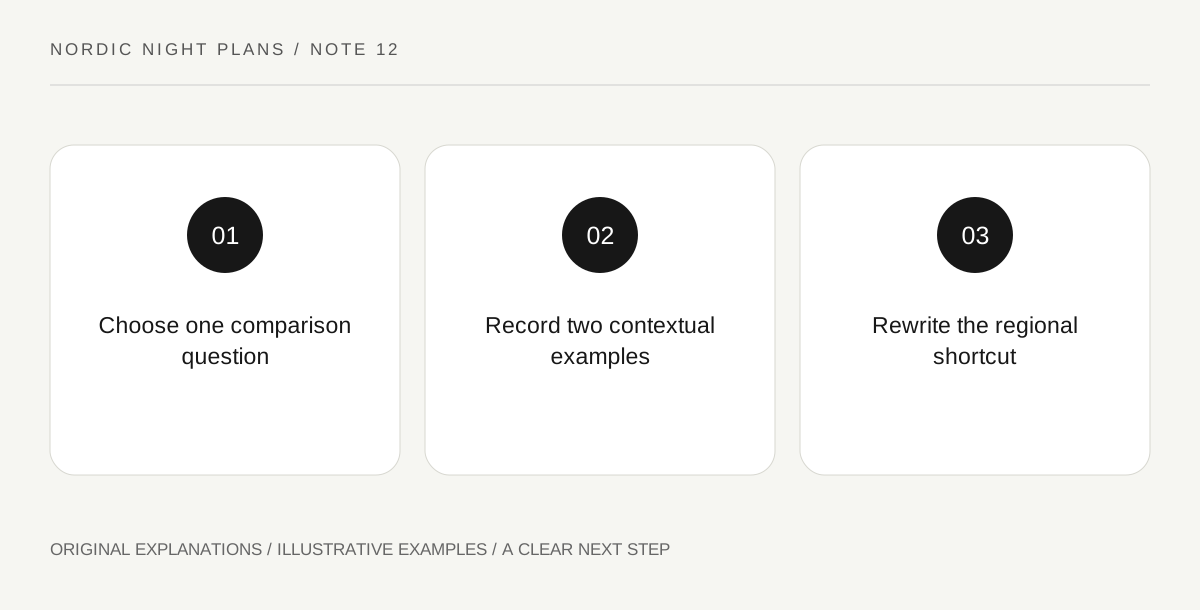
Original explanatory diagram. Read the full method and limitations below.
Use the exhibition’s own organization
Arktikum’s official description divides Northern Ways into Rovaniemi, Southern Lapland and Upper Lapland, with subjects including livelihoods, history and nature. Those divisions offer a practical reading structure rather than a claim that every community fits one simple category. Write the three region headings before entering the comparison. Choose one question, such as how work is represented, that can be asked consistently. The exhibition’s structure helps you notice variation without requiring a hurried attempt to cover every panel in equal detail.
Give each example a place and a time
For two selected displays, record the named locality or regional context and the historical period actually discussed. Then identify the evidence presented. An object and a personal account may illuminate different aspects of the same broad theme, but neither should be expanded into the experience of an entire region without support. If a label does not supply a date or locality, keep that absence visible. Precision matters because a general northern label can otherwise erase the very differences that make the comparison informative.
Compare the evidence, not imagined regional personalities
Ask how each display explains the selected theme. One may emphasize a task, another a change in settlement or an individual account, depending on what is actually presented. Describe that difference without assigning a personality to a whole population. Do not say one region is more traditional or more authentic because its objects look older. Your comparison concerns the interpreted evidence and its context. Where the displays answer different questions, acknowledge that rather than forcing them into a simplistic ranking.
Revise one line in the trip description
Return to the sentence you would have used to describe the journey before the visit. Replace a broad phrase about Lapland with a more specific place-and-subject relationship you can explain. Keep the conclusion proportionate to the two examples studied. The aim is not instant regional expertise; it is a better question and a less interchangeable memory. A late evening’s hoped-for sky event can remain part of the holiday while the daytime museum study gives named places and people their own historical weight.
Illustrative learning notebook
Illustrative comparison: a traveler chooses two interpreted livelihood examples from different regional sections. Each notebook entry includes the stated place, period and evidence type. The final paragraph compares how the displays explain work, leaving unsupported population-wide claims out. The revised trip journal names a particular subject rather than using Lapland as a single timeless setting for aurora photographs.
Questions that come up
Must I study all three sections equally?
No. A bounded two-example comparison can be useful. State its limits instead of suggesting it represents every part of the exhibition or region.
Can an old object stand for everyone’s life in a region?
No. Its interpreted context matters. Use it to investigate a particular subject rather than treating age or appearance as proof of a universal experience.
References and scope
These sources support the factual background. Examples and exercises are original illustrative teaching material. References do not imply endorsement.
- Arktikum: Northern Ways — The exhibition’s three-region structure and stated historical/livelihood/nature themes; no population-wide characterization or fixed display-access promise.