Ájtte: give a clothing object its context before reading its decoration
A decorated garment can quickly become a visual shorthand for an entire people in a traveler’s memory. At Ájtte in Jokkmokk, slow that process down. Choose one properly interpreted clothing or silver-related object and keep its maker, place, use and collection context attached where known, rather than inventing a symbolic meaning from an attractive detail.
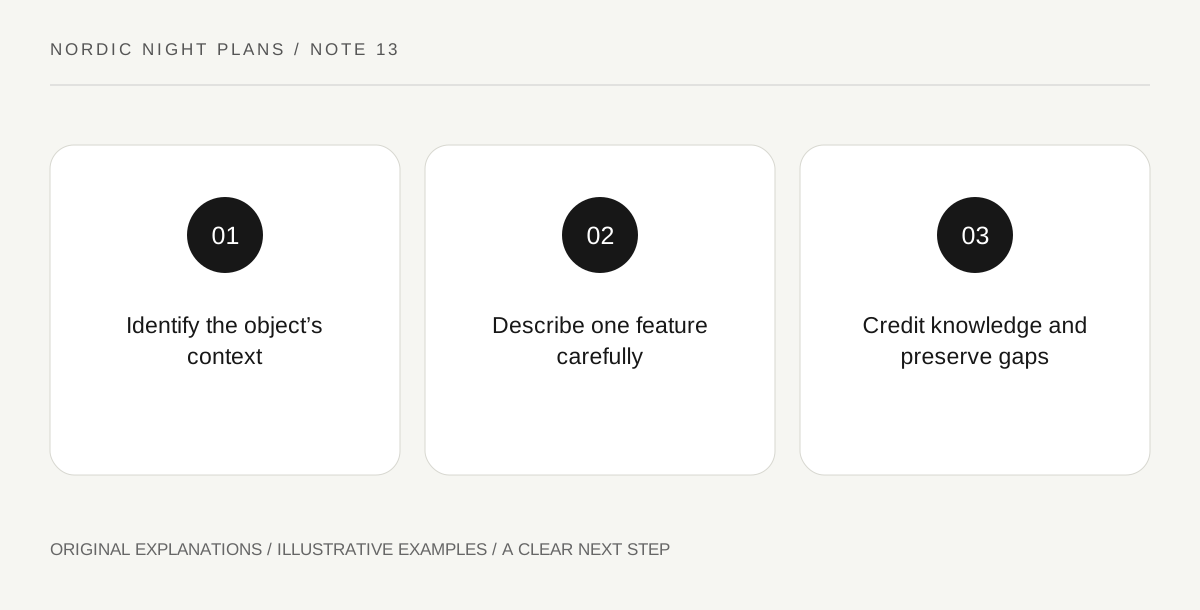
Original explanatory diagram. Read the full method and limitations below.
Begin with the museum’s stated subject
Ájtte describes itself as a museum of Sámi culture and the mountain region, and its English information identifies a clothing-and-silver exhibition theme. That supports a focused object study, not an assumption that every displayed object is interchangeable traditional dress. Read the particular label and use the museum’s terminology. The broad subject can guide your attention, while only the object’s own interpretation can establish its specific identity, cultural context and historical use.
Make an object identity card
Create fields for the named object, maker if identified, place or community context, period and stated use. Fill only what the interpretation supplies. An unknown maker should remain unknown rather than disappearing behind a generic culture label. Where the information distinguishes a maker from an owner or collector, preserve those roles. This simple card keeps the object connected to people and circumstances instead of turning it into an anonymous pattern sample for a travel mood board.
Describe decoration without decoding it by guesswork
Select one visible feature and describe its material, arrangement or relationship to the object’s larger form. Do not assign meaning to a color, motif or fastening because another display elsewhere used something similar. If the interpretation explains significance, record that explanation with its particular context. If it does not, write a question for appropriate museum staff or further reading. Curiosity is useful when it acknowledges the boundary between what can be seen and what can responsibly be interpreted.
Keep the collection encounter distinct from a costume idea
End with a caption that credits the information actually available and explains one feature you learned to notice. Respect photography conditions and avoid presenting the object as a prompt for imitation detached from context. A museum study can deepen appreciation without claiming permission, ownership or expertise in another community’s cultural expression. The resulting notebook gives a named or carefully contextualized object more attention than a generic northern souvenir image, and that makes it a worthwhile daytime subject on an aurora journey.
Illustrative learning notebook
Illustrative card: a visitor selects a labeled garment and records its stated context, leaving the maker field unresolved where no name is supplied. They describe a visible arrangement of material but decline to invent a motif meaning. The final caption credits the museum interpretation and distinguishes observation from an open question. It does not present the object as a universal Sámi outfit or a costume template.
Questions that come up
Can I infer a motif’s meaning from a similar object elsewhere?
Do not assume the same interpretation transfers. Meanings and contexts need appropriate evidence about the particular object or tradition.
Is an unknown maker a reason to ignore the object?
No. Record the knowledge gap explicitly while preserving the other context the museum provides. Unknown is more accurate than an invented attribution.
References and scope
These sources support the factual background. Examples and exercises are original illustrative teaching material. References do not imply endorsement.
- Ájtte: English museum and exhibition information — The museum’s Sámi/mountain-region remit and clothing-and-silver exhibition theme; no invented object attribution or symbolic interpretation.