STEVE: let an unfamiliar sky feature keep its scientific question
A striking purple ribbon in a sky image can make a memorable internet label feel like a complete explanation. Read STEVE as an example of an aurora-like phenomenon whose classification and physical details have required investigation. The useful skill is to preserve the difference between an appearance, a name and an evidence-based account of how the light is produced.
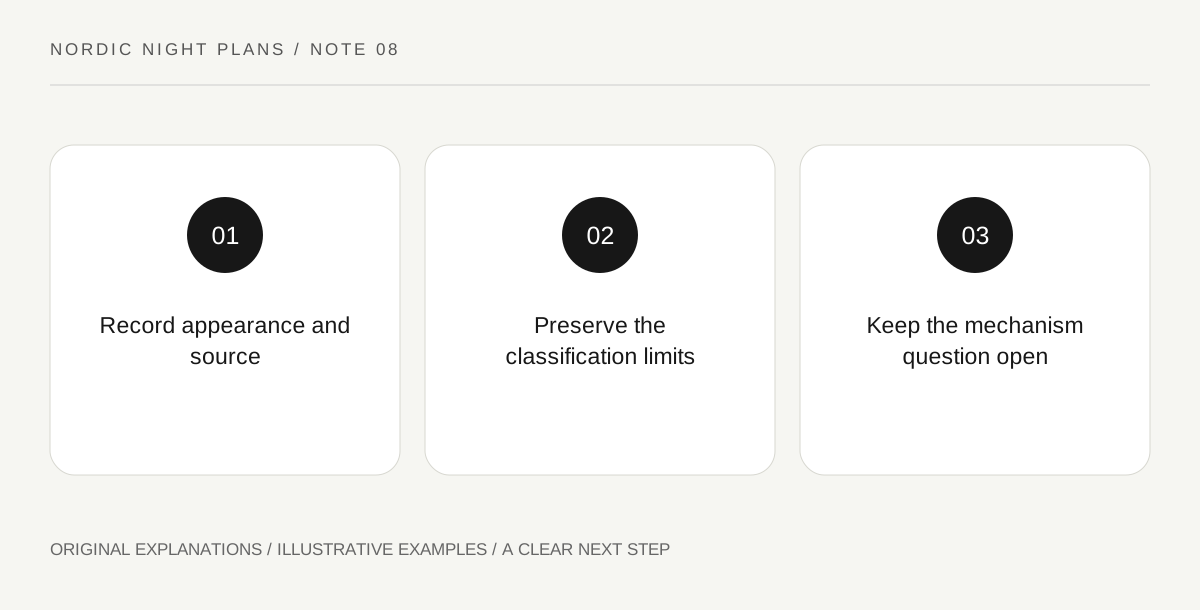
Original explanatory diagram. Read the full method and limitations below.
Record what the official account actually calls it
NASA’s account describes STEVE as an aurora-like feature that is not a normal aurora, while discussing research into its associated structures. Use that qualified description instead of forcing the feature into an ordinary-aurora category for convenience. Write the source date and the question under investigation. The purpose is not to freeze scientific understanding at one article’s publication date. It is to recognize the level of certainty stated by the account and avoid replacing it with a more confident social-media caption.
Separate the label from the observation
Make three lines: what the image or witness record describes, which name the source applies and what physical explanation the source supports. A name can make observations discussable without answering every mechanism question. Leave any unsupported field blank. Do not identify an unfamiliar personal photograph solely because its color seems similar to a published example. Image processing, context and the evidence used in a scientific identification matter, so a visual resemblance should remain a question rather than a claim of a rare discovery.
Read uncertainty as useful information
Look for words that signal whether a statement is a finding, a proposal or an unresolved question. Paraphrase those distinctions in your own notebook rather than stripping them out to make a tidier story. Scientific uncertainty does not make the research empty; it identifies what the evidence can and cannot yet establish. A traveler can learn from that boundary without needing to settle the classification personally. The important change is becoming comfortable with a specific open question rather than treating every unanswered detail as a reason to invent an answer.
Use the example to improve later captions
When describing an unusual sky image, attach its actual date, source and identification status. If the phenomenon is unverified, say so and avoid presenting it as a guaranteed attraction on a tour. STEVE is a useful case study because appearance, classification and mechanism do not collapse into one simple label. A northern trip can inspire careful curiosity without becoming a competition to claim the rarest feature. End with a question you could take to a current authoritative research explanation, keeping your own observations separate from specialist conclusions.
Illustrative learning notebook
Illustrative caption: a traveler notices that an online image resembles NASA’s STEVE example. Instead of naming it definitively, they record the original image context and write identification unresolved. Their learning note distinguishes the published scientific example from the unverified comparison. No unusual color becomes a personal discovery claim, and the phenomenon is not advertised as something a future tour can provide on request.
Questions that come up
Does a memorable name explain the physical process?
No. A label can organize observations while questions about mechanism remain. Read what the research actually establishes.
Can I identify STEVE from purple color alone?
This article supplies no such identification method. A resemblance is not equivalent to the evidence and context used by researchers.
References and scope
These sources support the factual background. Examples and exercises are original illustrative teaching material. References do not imply endorsement.
- NASA: Aurora-Chasing Citizen Scientists Help Discover a New Feature of STEVE — The qualified description of STEVE as not normal aurora and the existence of continuing investigation; no current definitive classification or image-identification procedure.