Northern and southern aurora: compare observations without demanding mirror images
The names northern and southern lights can suggest a perfectly matched pair of displays. A scientific comparison needs more care than placing two attractive photographs beside each other. Use NASA’s paired ultraviolet observations to ask what was measured together, what differed and why a result about one observed interval should not become a universal statement about every night.
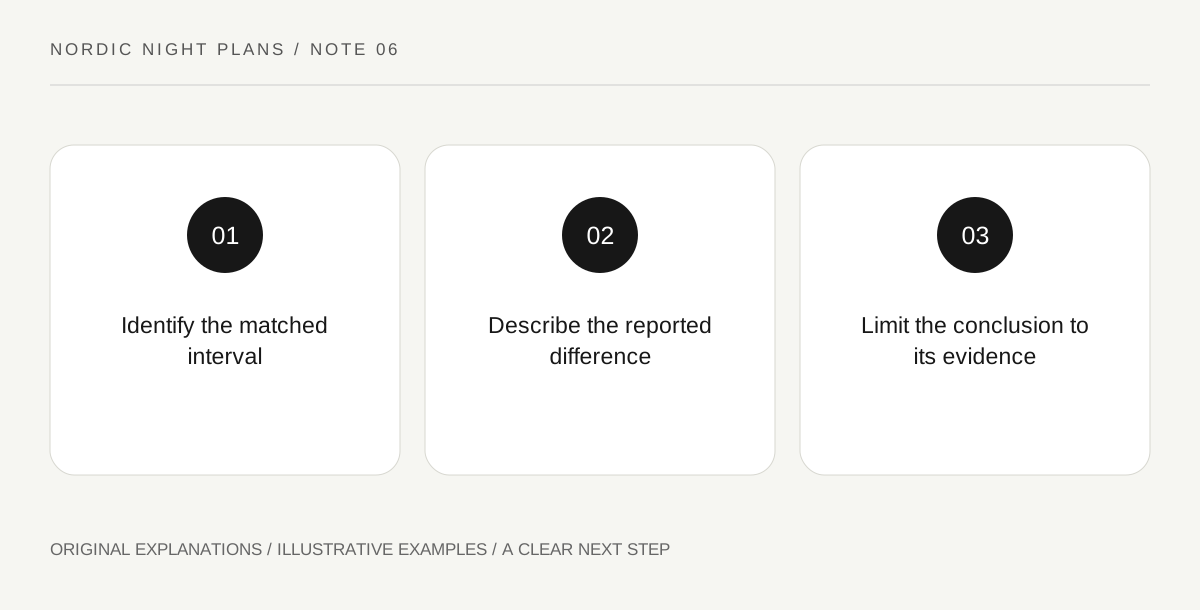
Original explanatory diagram. Read the full method and limitations below.
Read the observation’s actual scope
NASA’s Asymetric Aurora account presents satellite ultraviolet observations from both hemispheres during a specified interval in 2002 and discusses their differences. Its value here is a documented example that complicates a simple mirror-image assumption. Record the date, observing systems and comparison interval from the account. Do not relabel the image as current, or treat one historical event as a complete inventory of all possible north–south relationships. A carefully dated result remains educational without being a live description of the sky.
Align the evidence before comparing shapes
Check which row represents which hemisphere and how the images are oriented. Read the caption for time and instrument information instead of comparing only the apparent brightness of two colored frames. Write down any difference in presentation that the source identifies. If a detail is unavailable, leave it as a limitation rather than silently assuming identical conditions. This is a general comparison skill: the closer two images appear at first glance, the easier it is to overlook the information needed to interpret them together.
Describe a difference without inventing its cause
Choose one difference identified in the official explanation and state it narrowly. Then separate that observed difference from any proposed physical explanation discussed by the scientists. Do not diagnose a different pair of internet photographs using the same cause merely because their shapes also differ. An observation and its interpretation have distinct jobs. The notebook should preserve both, while making clear which claim belongs to the particular research example rather than to a travel photograph taken under unrelated circumstances.
Write the useful conclusion at the right scale
End with a sentence explaining why the mirror-image shortcut is inadequate, followed by the actual scope of the evidence. That conclusion can improve a conversation at a northern science exhibition without requiring you to calculate a conjugate location or plan a second-hemisphere trip. The lesson is about how comparisons are constructed. A Nordic night remains a local experience, while the research provides a wider context that includes both similarities and differences whose explanation depends on appropriately matched observations.
Illustrative learning notebook
Illustrative reading: a traveler sees paired hemispheric images and initially expects matching outlines. They identify the historical interval and ultraviolet context, then record a difference described by NASA. Their final note says this example challenges a simple mirror-image assumption. It does not claim that all aurora are always asymmetric or that two unrelated holiday photographs can establish the same research result.
Questions that come up
Do different images prove the hemispheres are unrelated?
No. Difference is not absence of a physical relationship. Use the research explanation rather than replacing one oversimplification with another.
Can two photographs taken on different nights test this claim?
They do not provide the matched observational context used in the cited example. Their differences may have many causes, so do not present them as equivalent evidence.
References and scope
These sources support the factual background. Examples and exercises are original illustrative teaching material. References do not imply endorsement.
- NASA Earth Observatory: Asymetric Aurora — The dated paired ultraviolet observations and reported hemispheric asymmetry; no universal or current-night claim.