Pulsating aurora research: ask why two kinds of measurement were needed
A video of changing light and a graph of particle measurements can look like two unrelated scientific exhibits. Pulsating-aurora research offers a way to connect them without pretending one image contains the whole explanation. Read a published research summary for the different questions answered from the ground and from space, then trace the limited link between them.
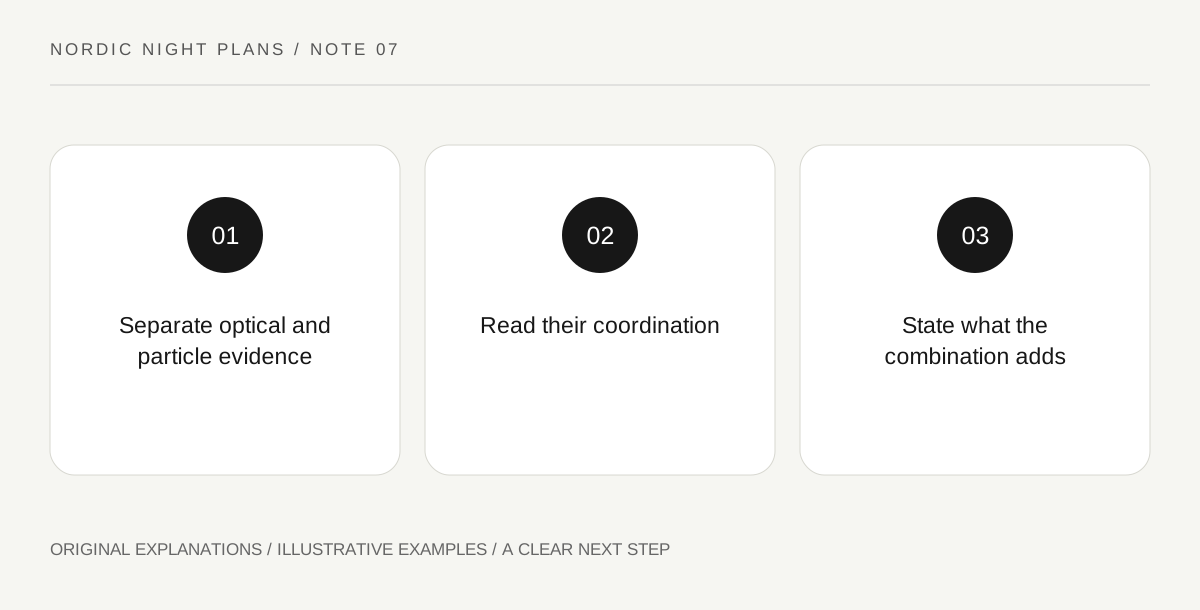
Original explanatory diagram. Read the full method and limitations below.
Name the two evidence streams
NASA’s account of pulsating-aurora research describes a comparison between ground-based video and satellite measurements of electron numbers and energies. That combination, rather than a particular visual shape alone, is the subject of this exercise. Make separate headings for optical observation and particle measurement. Identify the study’s stated interval and location from the source when relevant. Do not use the general word data to erase the distinction between the different physical quantities being observed.
Ask what each stream can establish
For the video, record the kind of change the researchers could examine. For the satellite measurements, record the measured particle information as described in the account. Avoid inventing numerical values absent from the public summary. The important question is what would remain unknown if either stream were removed. A visible change does not directly display every particle’s energy, while a particle measurement is not a complete image of the sky. Their different limitations are precisely what can make a coordinated comparison valuable.
Read coordination as part of the method
Look for how the summary connects the observations in time and space. A nearby date alone does not mean two measurements belong to the same research comparison. Write what the account actually establishes, and mark missing methodological detail for further reading. You do not need to recreate the analysis to understand why coordination matters. The exercise trains you to ask how two pieces of evidence became relevant to each other, rather than treating any graph placed beside an aurora photograph as its automatic explanation.
Keep a finding distinct from a personal sighting
End with one sentence about the research question and one about the role of the paired observations. If you later watch changing aurora on a trip, describe what you actually see without claiming to have reproduced the study. A traveler’s visual memory can be meaningful while remaining a different kind of evidence. The research summary gives that experience depth by showing how scientists move beyond appearance, using coordinated measurements to investigate a process that a single observer cannot establish from the ground alone.
Illustrative learning notebook
Illustrative worksheet: one column records what the study’s ground video shows; another lists the satellite’s stated electron measurements. The traveler then writes what information would be missing from either column alone. A final note identifies the coordinated comparison as the scientific method of interest. It contains no invented graph readings and does not diagnose an unrelated personal video as the same event.
Questions that come up
Can a video alone measure electron energies?
Not in the comparison described here. The point of the exercise is to distinguish optical observations from the particle measurements supplied by another instrument.
Must I understand every technical detail to learn from the study?
No. Identifying the research question, evidence streams and their coordination is a useful beginning, with detailed analysis left for appropriate further study.
References and scope
These sources support the factual background. Examples and exercises are original illustrative teaching material. References do not imply endorsement.
- NASA: Measuring the Pulsating Aurora — The study’s comparison of ground video with satellite electron measurements; no copied findings beyond that narrow methodological context.