Alta’s Traces in Stone: distinguish the figure from its former setting
A rock-art image can seem like a self-contained drawing when detached from its stone and landscape. Alta Museum’s Traces in Stone offers a way to question that impression indoors. Study one interpreted figure together with the information about its surface and setting, keeping the museum’s explanation separate from an invented story about what its maker intended.
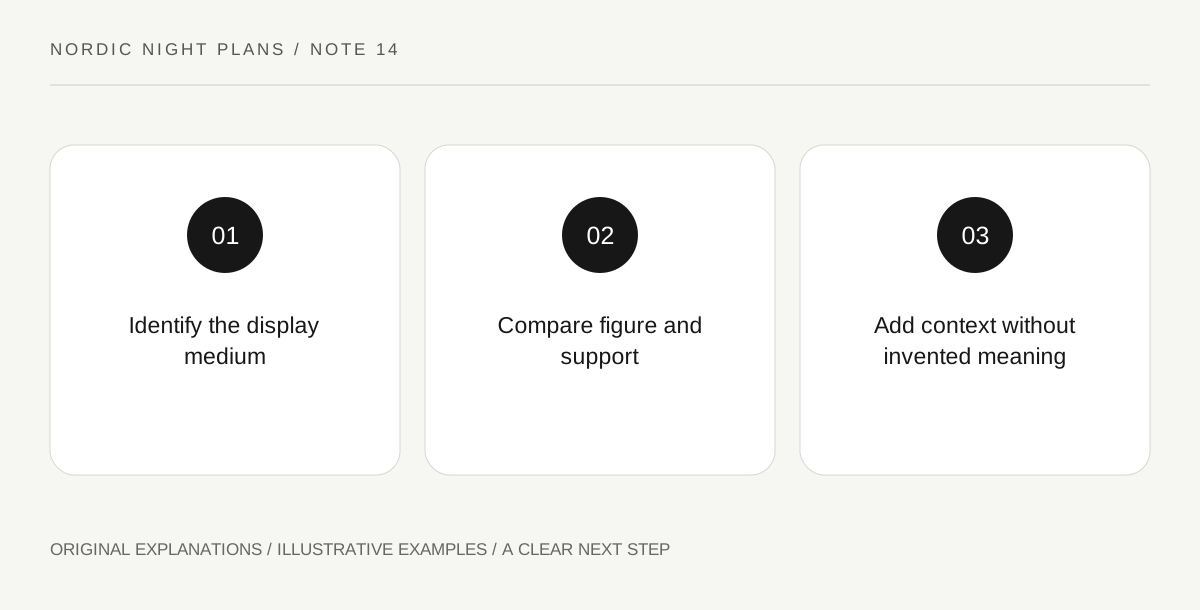
Original explanatory diagram. Read the full method and limitations below.
Use the exhibition’s wider question
Alta Museum explains that Traces in Stone considers not only figures but also their making, rock surfaces and contemporary environment, while acknowledging unanswered questions. This provides a focused subject for a northern cultural visit independent of any outdoor plan. Identify one display and record what kind of material you are examining: an original object, a reproduction, an image or an interactive interpretation as labeled. The categories matter because they give different kinds of access to the subject.
Describe the figure and support separately
Write one note about the depicted form and another about the surface or support described by the museum. A line may be easy to notice in a reproduced image while the material relationship is less obvious. Do not infer a carving technique from appearance alone or touch an object unless the museum explicitly designates it for that interaction. The exercise asks what changes when the figure is treated as something made on a particular surface rather than as a free-floating graphic.
Add the environmental interpretation carefully
Read the display’s explanation of the setting relevant to the selected example. Record only the relationship it establishes, then ask how that context changes the question you would ask about the figure. Avoid inventing a specific ritual, speech or biography to make the scene vivid. Archaeological interpretation can offer meaningful insights while retaining uncertainty. An unanswered question is not a blank space for the traveler to fill with a dramatic narrative that may later be mistaken for a museum finding.
Let the indoor study stand on its own
Finish with a caption combining figure, support and interpreted context, with any uncertainty clearly stated. An outdoor rock-art visit, if desired, has separate current arrangements and conservation boundaries; it is not required to make this study valuable. The indoor subject can provide a complete learning task during a northern trip. Its value lies in understanding why context matters, rather than using the exhibition merely as an introduction to a photograph you hope to obtain outside.
Illustrative learning notebook
Illustrative page: a traveler labels a display image as a reproduction and describes the figure separately from the stone information supplied beside it. An environmental explanation changes their first question, but the intended meaning remains uncertain. The final caption preserves that uncertainty. The traveler neither touches an undesignated object nor invents an outdoor access plan to make the indoor exercise feel complete.
Questions that come up
Can I invent a story to remember a figure?
A private imaginative response should be clearly labeled as such. Do not present it as the maker’s intention or the museum’s archaeological explanation.
Does an indoor study require an outdoor follow-up?
No. The display’s contextual question can stand on its own. Any outdoor visit needs its own current access and conservation information.
References and scope
These sources support the factual background. Examples and exercises are original illustrative teaching material. References do not imply endorsement.
- Alta Museum: Traces in Stone — The exhibition’s attention to figures, making, rock surfaces, environment and unanswered questions; no outdoor access or motif-meaning claim.