Magnetic reconnection: read an animation as an explanation, not a recording
An animation can make an invisible space process feel immediately obvious. That clarity is useful, but it can also hide the difference between observations and the visual explanation built from them. Read NASA’s THEMIS reconnection material by separating the scientific finding, the animation’s conventions and the questions a short illustration cannot answer about a particular northern night.
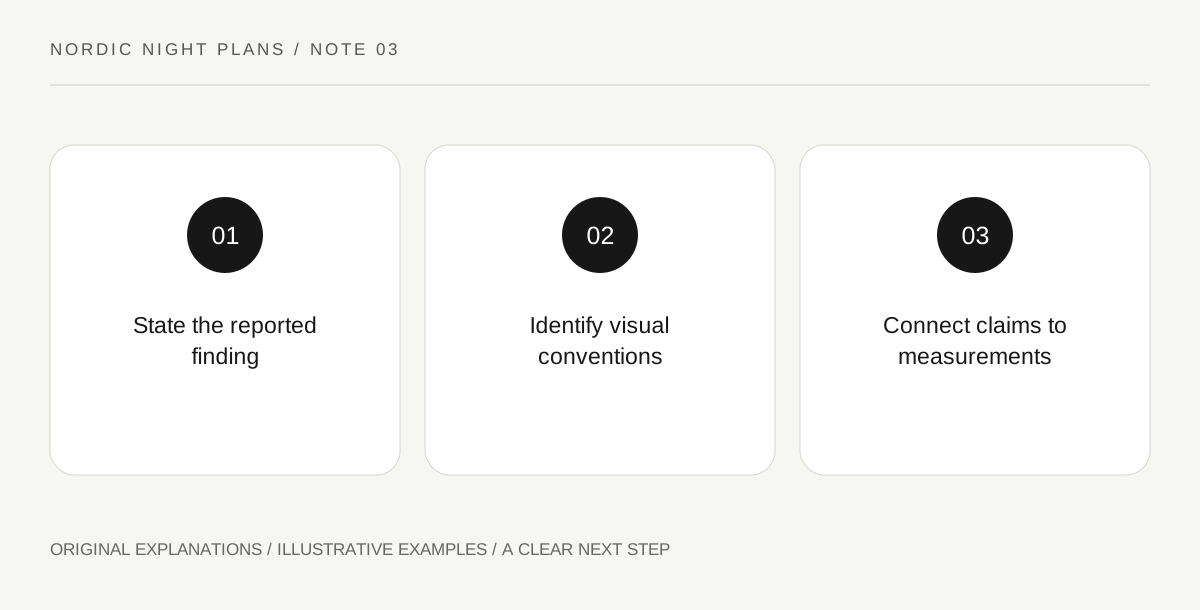
Original explanatory diagram. Read the full method and limitations below.
State the finding before studying the artwork
NASA’s THEMIS material reports observations connecting magnetic reconnection in the magnetotail with substorm onset. Use that carefully scoped finding as the starting sentence. It is not the same as claiming every visible change in every aurora can be traced from a holiday photograph to one reconnection event. Record the mission name and the scientific relationship being discussed. This gives the illustration a defined explanatory purpose before its moving lines and bright colors begin to supply a story of their own.
List what the animation chooses to show
Watch or examine the official visual once for its sequence, then again for its conventions. Note where it represents field geometry, spacecraft or Earth. Treat those as explanatory choices unless the caption says a particular element is actual data. An artist can show relationships from a viewpoint no single instrument occupied. That does not make the illustration unhelpful; it means you should not describe the entire scene as raw footage from space. Keep the distinction visible in your notes.
Ask which measurement supports which claim
Read the accompanying explanation for the observation involved. Write a question linking one reported measurement to the conclusion it helps support. You do not need to reconstruct the research analysis or claim expertise in it. The useful habit is to ask how a scientific statement is connected to evidence rather than accepting the animation’s apparent smoothness as proof. If a public summary does not contain enough detail, mark that limit and use the research references for a later inquiry instead of inventing instrument readings.
Bring the distinction into a viewing conversation
If a guide or exhibition mentions reconnection, you now have a precise follow-up: which part is a general mechanism and which part concerns this event’s evidence? That question can enrich a daytime discussion without turning the traveler into an amateur forecaster. End your notebook with a caption that explicitly calls the image an explanatory animation. Add the narrowly stated finding beside it. The two pieces work together, while their separate roles prevent a compelling visual sequence from being mistaken for an unbroken recording of cause and effect.
Illustrative learning notebook
Illustrative note: a visitor watches an official THEMIS animation and initially describes it as a spacecraft video of an entire substorm. After reading the caption, they revise it to an explanatory visualization accompanying a reported observation. The final page separates the finding from the artistic viewpoint and leaves the detailed measurement analysis as a research question rather than supplying imaginary data.
Questions that come up
Does an explanatory animation have less educational value?
No. It can clarify relationships that are hard to display directly. Its value improves when the reader understands what is represented and what was measured.
Can this explain the exact cause of every brightening I see?
No. General research context does not replace event-specific observations and analysis. Keep a personal sighting description separate from a causal diagnosis.
References and scope
These sources support the factual background. Examples and exercises are original illustrative teaching material. References do not imply endorsement.
- NASA Scientific Visualization Studio: THEMIS Sees Magnetic Reconnection — The reported THEMIS connection between magnetotail reconnection and substorm onset; not an event-specific forecast or diagnosis.