From collision to light: write an aurora explanation without colored arrows
An explanation of aurora can sound complete while skipping the step that creates light. Use a short prose exercise to connect energetic particles with the upper atmosphere and the emission that follows. The goal is a clear causal story, not a catalog of colors or an attempt to diagnose a particular photograph from its appearance.
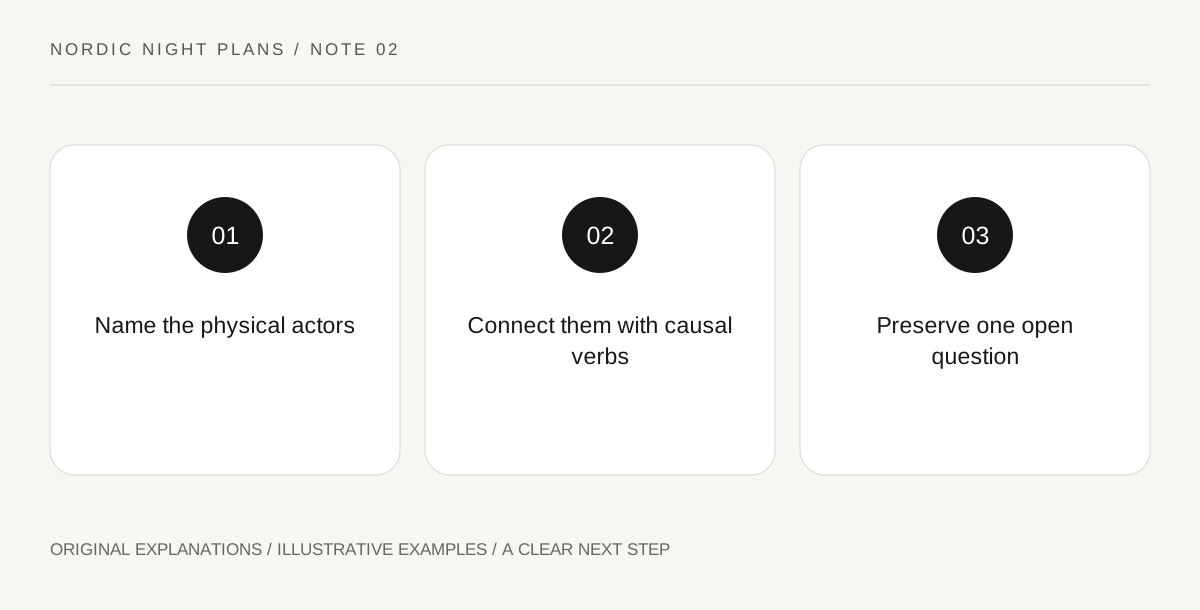
Original explanatory diagram. Read the full method and limitations below.
Keep the source’s physical actors distinct
NASA’s heliophysics education material explains that accelerated charged particles, usually electrons, interact with atoms and molecules in the upper atmosphere, which can then release light. Write those participants as separate nouns on a page. Do not merge the incoming particle and the atmospheric constituent into one glowing object. A simple explanation becomes more accurate when it preserves who carries energy and what emits the light, even before introducing any detailed atomic vocabulary or the processes responsible for particle acceleration.
Use verbs to expose a missing step
Write a chain of three short sentences: energy is carried, an interaction transfers energy and light is emitted. Add only details that the source actually supports. If your first draft says particles become green, underline that phrase and ask what physical step it has hidden. The point is to improve the explanation rather than choose a more impressive verb. A reader should be able to distinguish movement of particles from production of light without needing to imagine literal colored paint traveling along a line in a diagram.
Test the explanation with a non-color question
Ask whether the draft would still make sense if no image were attached. It should identify a process, not merely describe a luminous appearance. Now remove any claim about an individual display that the general source cannot establish. A broad mechanism does not identify the exact particle distribution or atmospheric conditions behind a traveler’s photograph. This is a useful boundary: the exercise teaches why light can be produced while leaving detailed event analysis to appropriate measurements and specialists.
Keep one version for a trip conversation
Reduce the explanation to a few clear sentences that you could discuss at a science centre or with a knowledgeable guide. Leave a final line for the next question, such as how particles gain their energy. Do not fill that line with an invented answer just to make the paragraph feel finished. A compact explanation with one honest open question is a strong learning outcome. It gives the northern night a physical story while keeping a general educational account separate from any promise about the conditions during your visit.
Illustrative learning notebook
Illustrative revision: a traveler’s draft says solar particles paint the sky. The revised version distinguishes energetic electrons, atmospheric constituents and emitted light. It then asks where the particle energy comes from. The notebook explains a general mechanism without claiming that the traveler has measured the composition, height or energy of the particular display shown in an accompanying holiday image.
Questions that come up
Does this exercise identify the gas in a personal photograph?
No. A general causal explanation is not a measurement of a specific image. Detailed identification requires appropriate evidence beyond this exercise.
Must the explanation include advanced equations?
No. A careful sequence of actors and actions is useful at an introductory level. Add technical detail only when it clarifies the process and you understand its source.
References and scope
These sources support the factual background. Examples and exercises are original illustrative teaching material. References do not imply endorsement.
- NASA: Heliophysics Big Idea 1.2 — The particle–upper-atmosphere interaction and emission of light; no event-specific gas, height or energy estimate.