Alfvén waves: keep the laboratory result separate from the sky analogy
The phrase electrons surfing a wave is memorable enough to become an explanation all by itself. Read it more carefully before using it on a northern-lights trip. Compare what a laboratory experiment demonstrates with the analogy used to communicate it, and leave the scale and setting of the real space environment clearly distinct.
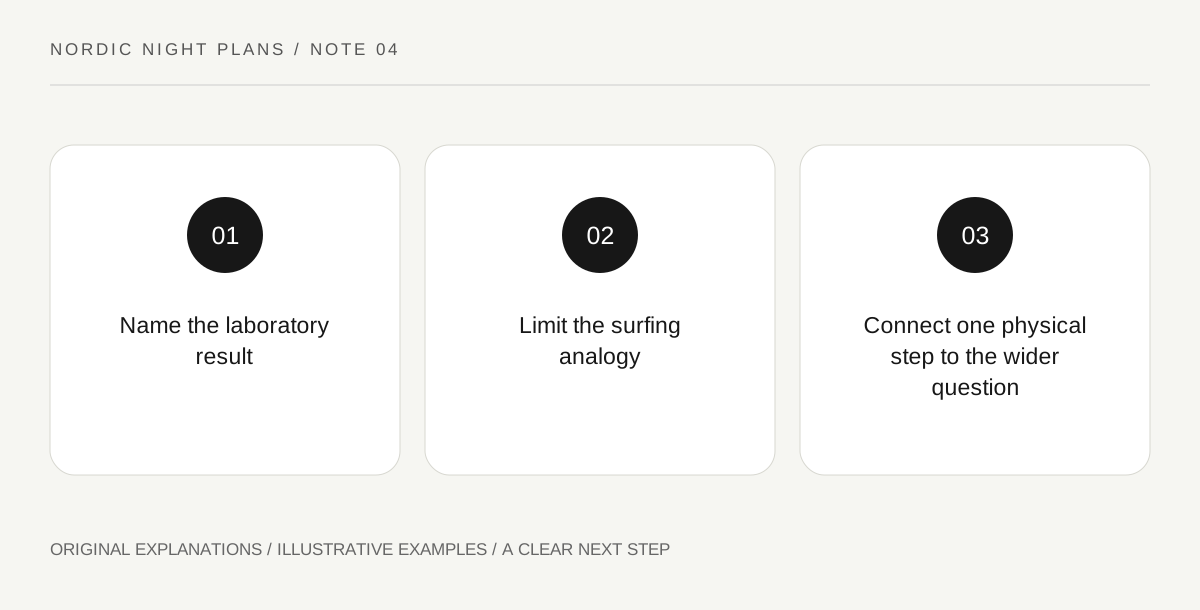
Original explanatory diagram. Read the full method and limitations below.
Identify the actual result
NASA reports laboratory observations of electrons gaining energy from a type of plasma wave, helping explain an auroral acceleration mechanism. That is the limited physical connection this article uses. Write laboratory result at the top of the page and note what was observed in the experiment. Do not replace the experiment with a picture of an ocean wave or claim that the laboratory reproduced an entire aurora over a Nordic landscape. A focused physical result can be important without containing every part of the larger phenomenon.
Give the analogy a useful job
Write what surfing helps a beginner imagine: energy transfer involving a moving wave and particles. Then write where the analogy stops. It does not make the electrons tiny people balancing on liquid water, nor does it establish a visible wave that a traveler can photograph directly. An analogy earns its place by illuminating one relationship. When it begins adding unmeasured details, it becomes a source of confusion. Keep the useful relationship and discard the extra story instead of treating vividness as scientific completeness.
Compare the settings explicitly
Create two columns labeled laboratory and space environment. In the first, list only experimental conditions or observations stated in the official account. In the second, record the auroral question the research addresses. Leave unmatched fields empty rather than assuming equal size, duration or complexity. This is not an invitation to perform a plasma experiment at home. It is a reading method that helps you see how controlled research can illuminate a natural process while still requiring care in connecting the two settings.
Write a travel-sized explanation with a boundary
Finish with a short paragraph that identifies the wave–particle energy-transfer idea, attributes the laboratory finding and clearly marks the analogy. Add one question you would ask at a science exhibition about the larger auroral system. Avoid turning the result into a local viewing indicator. The value for a traveler is a more satisfying explanation of one physical step, with a clear sense of how it was studied. That is richer than repeating a slogan while silently assuming the experiment measured the sky above the hotel.
Illustrative learning notebook
Illustrative page: a traveler writes surfing in quotation marks, then lists the energy-transfer relationship it is meant to convey. A second note identifies the laboratory setting and the auroral acceleration question. The final explanation does not equate the experiment’s dimensions with Earth’s magnetosphere and includes no claim that seeing a particular sky shape reveals this mechanism directly.
Questions that come up
Is surfing meant literally?
No. It is a communication analogy for a wave–particle interaction. Use the official explanation to understand the intended physical relationship.
Does one laboratory result explain every aspect of aurora?
No. It addresses a particular mechanism within a larger system. Other processes and observations remain necessary for a complete account.
References and scope
These sources support the factual background. Examples and exercises are original illustrative teaching material. References do not imply endorsement.
- NASA: Lab Experiments Shed New Light on NASA Satellite Observations — Laboratory evidence for electron energy gain through plasma-wave interaction; no experimental procedure or local prediction.