Tromsø’s Polar Museum: look for the work around an expedition headline
An expedition story can shrink into a famous name, a destination and a dramatic date. At Tromsø’s Polar Museum, use a different question: what practical and everyday work does the interpretation reveal around the headline? A focused evidence trail can broaden the story while keeping documented people and roles distinct from support work merely imagined by a visitor.
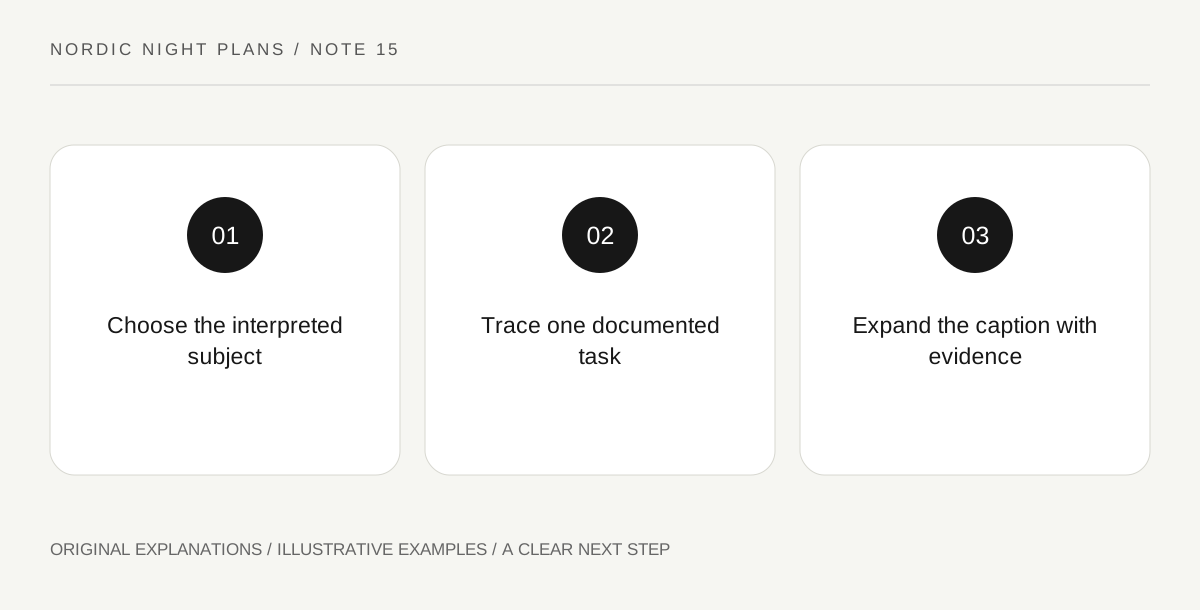
Original explanatory diagram. Read the full method and limitations below.
Choose a subject within the museum’s remit
The Polar Museum’s official visitor information identifies Arctic hunting and trapping, Norwegian polar expeditions and Svalbard’s cultural history among its permanent-exhibition subjects. Select one interpreted expedition or work-related display rather than assuming every room tells the same heroic narrative. Write the exact subject and period from the label. The museum’s broad remit supports a question about everyday activity, but specific roles and people still need the evidence supplied by the particular display.
Trace one documented task
Look for an object, account or image that explains an actual task. Record what the interpretation says was done, by whom if identified and under what circumstances. Keep the task concrete without turning the article into instructions for hunting, polar travel or equipment use. An object can be studied as historical evidence even when no operational demonstration is appropriate. The aim is to understand a documented contribution, not to reproduce it or assume that old practices are suitable for a modern visitor.
Notice who is named and who is not
Create separate fields for named participants, described but unnamed roles and your own questions about missing information. Do not invent a forgotten helper to balance the story or assume that an absent name proves a particular historical exclusion. The notebook can ask why certain work receives more interpretive attention while remaining honest about the evidence available. This is a useful way to read expedition history critically without replacing a narrow familiar narrative with an equally unsupported alternative.
Write a fuller caption with a bounded claim
End with a short explanation of how the documented task changes your understanding of the selected subject. Keep the famous destination or person in context, while giving the supported work its own sentence. A cultural visit during an aurora trip need not be a generic bad-weather substitute. This task has an independent historical purpose: seeing how a large event can depend on activities that a headline does not communicate. Leave unresolved roles as questions for the museum’s research or collection information.
Illustrative learning notebook
Illustrative note: a visitor chooses an expedition-related display and studies one labeled work object. The interpretation establishes a task but does not name every participant. The notebook gives the task a clear role, lists the identified person where supplied and leaves other identities unknown. It neither invents a helper’s biography nor turns a historical object into practical polar-travel advice.
Questions that come up
Must every missing name be filled in to tell a useful story?
No. An explicit knowledge gap is more responsible than an invented identity. You can explain the supported task while preserving that gap.
Is this a practical guide to Arctic expeditions?
No. It is a museum-reading exercise concerning historical evidence. Modern polar activities require their own qualified providers and current arrangements.
References and scope
These sources support the factual background. Examples and exercises are original illustrative teaching material. References do not imply endorsement.
- UiT: Plan your visit to The Polar Museum — The permanent-exhibition subjects of hunting/trapping, Norwegian polar expeditions and Svalbard cultural history; no invented task, biography or fixed opening schedule.