A northern art collection: let one work resist the travel brochure
A traveler arriving for aurora can unconsciously expect every northern image to confirm a familiar landscape. Use Nordnorsk Kunstmuseum’s collection as a chance to challenge that expectation. Study one properly identified work on its own terms, keeping the artist, medium and context visible rather than asking the collection to illustrate the holiday you had already imagined.
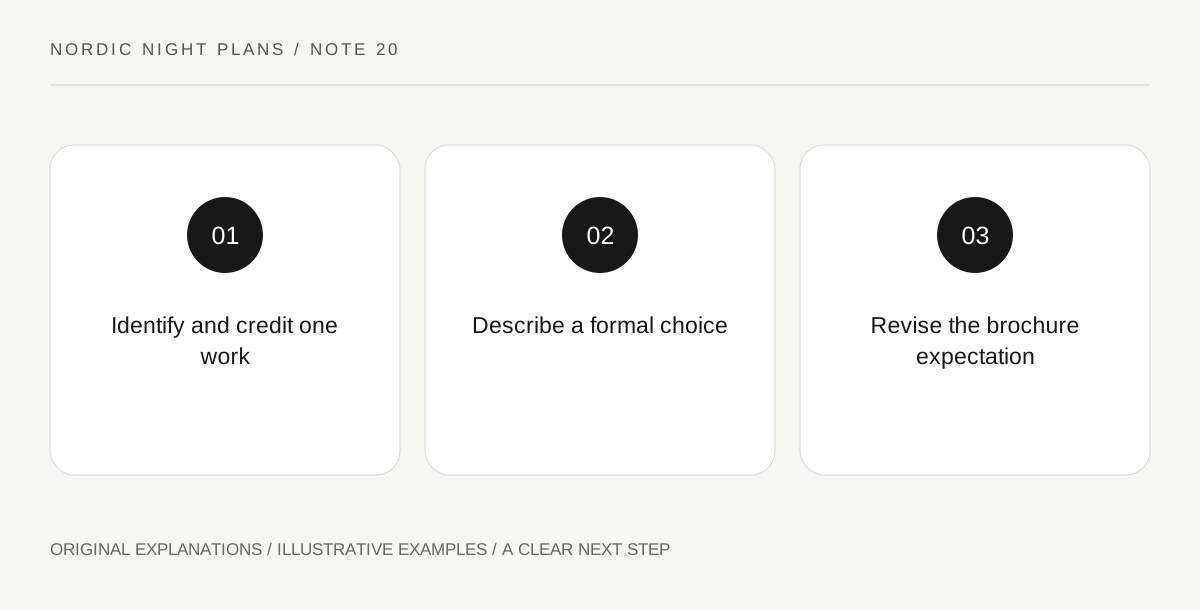
Original explanatory diagram. Read the full method and limitations below.
Start with the collection’s breadth
Nordnorsk Kunstmuseum describes a collection spanning historical and contemporary works, with diverse techniques and perspectives and increasing representation of Sámi artists and makers. That breadth is the reason to avoid treating northern art as one scenic category. Use the museum’s current exhibition information or its official collection resource to choose a work. A collection record does not guarantee that the object is on display during your visit. Keep the mode of encounter clear from the beginning.
Give the work an identity before a reaction
Record the artist’s name, title, date and medium where the official record supplies them. Leave missing fields unresolved. Then write a first response in plain words, clearly identified as your response rather than the artist’s declared intention. A work may not depict a landscape at all, and that is not a failure to represent the North. The exercise begins by making room for a subject and viewpoint that your travel expectations may not have anticipated.
Look for one formal choice that changes the reading
Choose a visible relationship within the work: scale, repetition, material contrast, framing or another feature you can describe accurately. Explain how it affects your attention without pretending that the observation alone reveals cultural meaning. Read the museum’s interpretation for any supported context. If your first response changes, preserve both versions and identify what prompted the revision. The contrast can be more useful than a polished final opinion because it shows how looking and learning interact.
Keep the artist separate from your itinerary
End with a caption that gives the work its proper credit and states one question it raised. Avoid using it as proof that an entire region feels a certain way or that an artist intended to celebrate a visitor’s preferred view. Respect reproduction and photography conditions. The northern journey gains something valuable when a collection complicates the brochure image rather than confirming it. This encounter can stand independently of the weather and of whether the trip eventually includes a visible aurora.
Illustrative learning notebook
Illustrative response: a traveler selects a work from the official online collection and labels the encounter as digital. Their first note expects scenery; the work’s material arrangement prompts a different question. After reading the record, they revise the response and preserve the artist’s credit. The final caption makes no claim that the object was physically displayed or that it represents every northern experience.
Questions that come up
Does a collection listing mean a work is currently on display?
No. Check the actual current exhibition information if seeing that work in person is essential to the visit.
Must northern art depict snow, mountains or aurora?
Do not impose that expectation. The collection’s stated breadth invites attention to different subjects, techniques and perspectives.
References and scope
These sources support the factual background. Examples and exercises are original illustrative teaching material. References do not imply endorsement.
- Nordnorsk Kunstmuseum: The Collection — The collection’s historical/contemporary breadth, varied perspectives and Sámi representation; no fixed on-display claim or invented artwork details.