Jupiter’s moon-linked aurora: compare planets without exporting an Earth rule
A northern-lights journey can prompt an unexpectedly useful question about other worlds: what remains similar, and what changes, when scientists study aurora elsewhere? Use Jupiter’s moon-linked auroral signatures as a comparison. The exercise is to separate a shared broad phenomenon from a particular planetary relationship that should not be imported into explanations of Earth’s night sky.
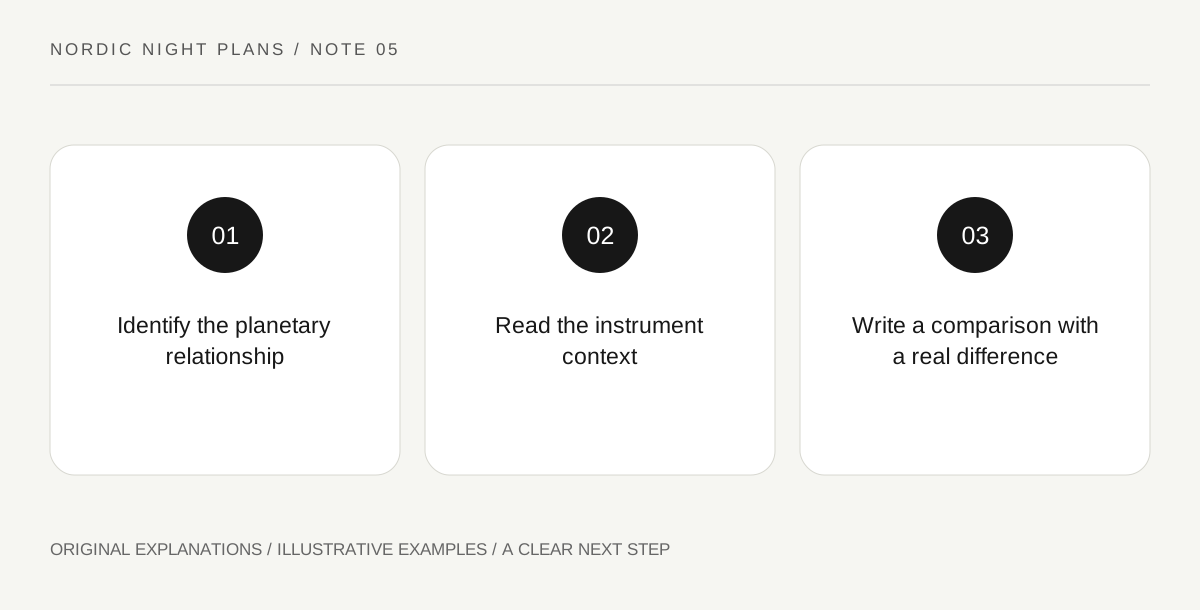
Original explanatory diagram. Read the full method and limitations below.
Begin with the named planetary relationship
NASA’s Juno account describes distinct auroral signatures associated with Jupiter’s large moons, often called satellite footprints. It explicitly contrasts this with Earth’s Moon, which does not produce the same phenomenon. Record the planet, moon relationship and mission before looking at the image. These nouns matter. A familiar luminous feature can encourage an incorrect shortcut if the reader assumes that every aurora in the Solar System must have the same immediate driver or the same observational appearance.
Read the image’s identity before its colors
Find the caption’s instrument, represented wavelength or processing information where supplied. Record what is actually being shown and which markings identify the moon-linked signatures. Do not interpret display colors as a naked-eye view from a spacecraft window unless the source establishes that. The useful comparison concerns relationships among a planet, its space environment and its moons, not which holiday camera setting would reproduce the picture. Keep scientific image conventions attached to the image when saving a notebook reference.
Build a comparison with an explicit difference
Make two columns for Earth and Jupiter. Add the limited facts supported by the relevant explanation, leaving the Jupiter moon-footprint relationship on its proper side. Then state what the comparison helps you ask about Earth, such as which objects and energy sources belong in an explanation. Do not fill the table with remembered numbers or assumed equivalences. A small accurate comparison is more valuable than a broad chart whose confident rows conceal unsupported transfers from one planet to another.
Return to the Nordic night with a sharper question
End with a sentence about what you learned from the difference. You might now ask a science-centre educator which parts of a general aurora explanation are Earth-specific and which concern a broader class of interactions. That is an educational question, not a viewing forecast. Keep the planetary image as context for curiosity rather than a preview of what the northern sky should look like. The comparison enriches the trip precisely because it shows that a shared word can contain different physical relationships.
Illustrative learning notebook
Illustrative comparison: a traveler labels a Juno image with Jupiter, the relevant moon signatures and the caption’s imaging context. Their Earth column explicitly excludes an equivalent lunar footprint claim. The final note asks how auroral systems differ between planets. It does not treat a processed spacecraft image as a naked-eye northern-lights photograph or infer a local display from Jupiter’s activity.
Questions that come up
Does Earth’s Moon make the same auroral footprints?
The cited NASA explanation explicitly distinguishes the Jupiter moon-linked phenomenon from Earth’s Moon. Do not transfer that relationship to Earth.
Is a spacecraft aurora image a preview of a Nordic sighting?
No. It concerns another planetary system and particular instruments. Its role here is scientific comparison, with the imaging context preserved.
References and scope
These sources support the factual background. Examples and exercises are original illustrative teaching material. References do not imply endorsement.
- NASA: Juno Detected the Final Missing Auroral Signature from Jupiter’s Four Largest Moons — Jupiter’s moon-linked auroral signatures and the explicit contrast with Earth’s Moon; no universal planetary mechanism or visual equivalence claim.